
Why and How to Invest in Barcoding Across Your Manufacturing Operation
13th Aug 2026
If you walk onto any manufacturing floor, you’ll see thousands of moving parts, raw materials arriving at the loading dock, components moving through work-in-progress (WIP) bays, and finished goods heading out the door.
Yet, too many production environments are still held together by clipboard checklists, manual data entry, and guesswork.
At The Labelman, we see it all the time: a mislabeled pallet delays an entire freight line, or a missing bin of raw steel halts production for hours. If you want to scale your operations, trim waste, and ensure 100% traceabilty, implementing a robust barcode ecosystem isn't an option, it's a necessity.
Here is why your manufacturing facility needs to invest in barcoding, and a practical step-by-step guide on how to roll it out.
Part 1: The "Why" - What Barcoding Actually Solves
Barcoding isn't just about sticking labels on boxes; it's about real-time visibility across your entire supply chain.
1. Eliminating Human Error in WIP (Work-in-Progress)
Manual data entry carries an average error rate of about 1 in every 300 keystrokes. Barcode scanning slashes that error rate to less than 1 in 3 million. Whether you are tracking batch numbers through a powder-coating booth or checking component parts against a Bill of Materials (BOM), scanning eliminates expensive assembly mistakes.
2. Complete Batch & Lot Traceability
When a quality issue arises or a supplier issues a component recall, how fast can you isolate the affected units? With a barcoded inventory system, every raw material roll, sheet, or fitting is linked to a lot number. You can trace a defect back to its source in seconds rather than days.
3. Accelerated Order Dispatch & Picking Speed
Stop requiring warehouse staff to memorise bin locations or hunt for unlabelled freight. Equip your team with rugged mobile computers, and they can pick, verify, and pack orders at twice the speed with total accuracy.
4. Maximising Hardware & Software ROI
Whether you use SAP, Microsoft Dynamics, or Sage, your ERP system is only as good as the data fed into it. Barcodes give your software system live, ground-truth data from the factory floor.
?️ Part 2: The "How" - Building Your Barcoding Strategy
Rolling out a barcoding system across a manufacturing facility doesn't have to be overwhelming. Here is how to structure your implementation:
Step 1: Audit Your Operational Touchpoints
Map out your factory floor and identify every point where a physical asset moves:
Goods-In: Receiving raw materials and assigning lot/supplier tags.
Production/WIP: Tracking parts moving from raw stage to assembly to finishing.
Finished Goods: Applying permanent serial tags or rating plates.
Warehouse & Logistics: Outer carton shipping labels and SSCC pallet tags.
Step 2: Choose the Right Media & Adhesive (The Critical Foundation)
A barcode scanner is useless if the barcode itself is unreadable. A standard paper shipping label will not survive a harsh manufacturing environment.
Harsh Environments & Chemical Exposure: Use Synthetic (Polypropylene or Polyester) Labels paired with high-durability Resin Ribbons to resist oils, abrasion, and heat.
Initial Production/WIP: Use heavy-duty, non-adhesive Tag Stock that can be wired onto unpainted metal parts or timber frames.
Standard Shipping & Freight: Use high-tack Direct Thermal or Thermal Transfer Labels that resist scuffing in transit.
Step 3: Match Hardware to Your Factory Environment
Don't send retail-grade equipment into an industrial work zone.
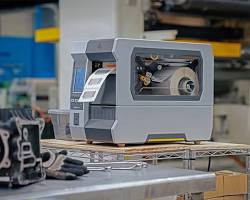
Industrial Thermal Printers: Deploy heavy-duty desktop or industrial printers (like Zebra's ZT series or print engines) directly on the factory line for continuous label generation.
Mobile Scanning & Handheld PDAs: Equip floor operators with rugged Android mobile computers (such as Zebra TC series or high-value Newland AIDC handhelds) that feature drop-spec protection and long-range scanning.
Step 4: Standardise Your Barcode Formats
Decide on your barcode architecture early:
1D Barcodes (Code 128 / EAN): Perfect for standard linear scanning on cartons and shipping labels.
2D Barcodes (Data Matrix / QR Codes): Essential if you need to pack massive amounts of data (serial numbers, manufacture dates, batch codes) into a tiny footprint on small component parts.
The Labelman’s Bottom Line
Investing in barcoding isn't just a technology upgrade, it's an operational safety net. It protects your business from costly mis-ships, reduces labour waste, and gives your customers total confidence in your supply chain reliability.
Whether you need guidance on setting up thermal transfer print stations, choosing chemical-resistant synthetic label stock, or finding the right mobile scanners for your budget, The Labelman team is here to help.
Ready to audit your factory floor labeling?
Reach out to our team today to request a custom sample pack of industrial media or discuss hardware options for your facility!