What's the difference between a 1D and 2D scanner?
16th Jul 2026
1D vs. 2D Scanners: What You Need to Know for the "Sunrise 2027" Transition
At the Labelman, we spend our days helping businesses get their inventory and operations running like clockwork. Lately, the most common question we get is: "Do I really need to upgrade to 2D scanners?"
The short answer is yes, and the reason is sitting right on your packaging: the global shift to 2D barcodes, often called the "Sunrise 2027" initiative.
Here is the breakdown of why the landscape is changing and which scanner is right for your operation.
The Basics: What’s the difference?
1D Scanners These are your classic laser scanners. They read the familiar vertical lines, the UPC codes we’ve all been using for decades.
-
The Tech: They use a laser to "sweep" across the lines, measuring the reflection to decode the data.
-
The Limit: They only read horizontally. If the barcode is damaged, smudged, or curved, a 1D scanner often struggles.
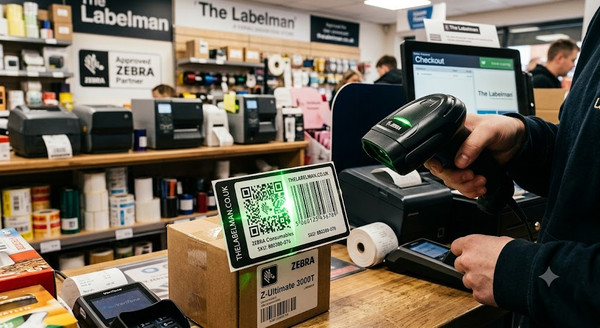
2D Scanners Think of a 2D scanner as a tiny, high-speed camera. Instead of just reading lines, it snaps an image of the entire symbol (like a QR code or Data Matrix).
-
The Tech: They use "area imaging" technology. Because they take a picture, they can read a code from any angle.
-
The Benefit: They handle damage much better and can hold exponentially more information, including batch numbers, expiry dates, and serial numbers.
The "Sunrise 2027" Shift: Why GS1 Matters
If you sell products or manage supply chains, you have likely heard of the GS1 Sunrise 2027 initiative.
For years, the standard has been the linear (1D) UPC barcode. However, GS1 is leading a global transition to 2D barcodes (like GS1 QR codes or GS1 DataMatrix) on consumer packaging by the year 2027.
Why the change?
-
Transparency: A 1D code only gives you a product ID. A 2D code can carry a "digital birth certificate"—including the batch number, expiration date, and traceability info.
-
Consumer Engagement: A 2D code allows customers to scan the product with their smartphone to see sustainability information, recipes, or allergen data.
-
Inventory Efficiency: For warehouses, a 2D code allows you to scan one symbol and capture the product ID and the expiration date instantly, drastically reducing errors.
The Bottom Line: If you buy a 1D scanner today, it cannot read these new 2D codes. By 2027, your 1D hardware will essentially be obsolete for modern retail and supply chain workflows.
Comparison Summary
Labelman’s Advice: Future-Proof Your Business
If you are currently running a warehouse or a retail floor, don’t wait until 2027 to scramble for an upgrade.
If you are buying new hardware, I always recommend jumping straight to 2D imaging technology. It’s more versatile, it future-proofs your business against the GS1 transition, and it’s actually faster and more reliable even if you’re only scanning standard 1D codes for now.
Are you unsure if your current scanners are ready for the GS1 2D transition? Drop us an email or call with your current model numbers, and we'll be happy to check if they are "Sunrise ready" or if we need to look at an upgrade plan.
01903 744139
sales@thelabelman.co.uk